Prince's Cabinet
The Prince’s Cabinet is the term used to describe the principality’s government. Its role is to organise activities, examine and support the Principality’s projects, and showcase local talent and expertise. It is also responsible for maintaining good relations with micronations around the world, with the aim of fostering exchanges.
The Prince’s Cabinet is made up of citizens motivated by the idea of carrying out useful initiatives for their town whilst having fun: combining the useful with the enjoyable, in line with the means and resources available to us in Aigues-Mortes. Together, these men and women are building the principality to make it a wonderful experience of solidarity.
The Prince’s Cabinet has organised several evening events that have showcased the talents of around sixty local artisans and involved the participation of over forty local traders. Its work has led to the creation of our television channel RTAM, initiated the process of introducing the Flamant (our local currency), contributed to the launch of a music festival, supported a food self-sufficiency project, and organised an international summit to welcome French-speaking micronations from several countries.
Prince Jean-Pierre IV serves as President of the Prince’s Office. For every project undertaken by the Principality of Aigues-Mortes, His Serene Highness ensures rigorous management whilst upholding the principles and values of our micronation. He also ensures that all legal aspects concerning the civil liability of the Principality of Aigues-Mortes are addressed before approving any project.
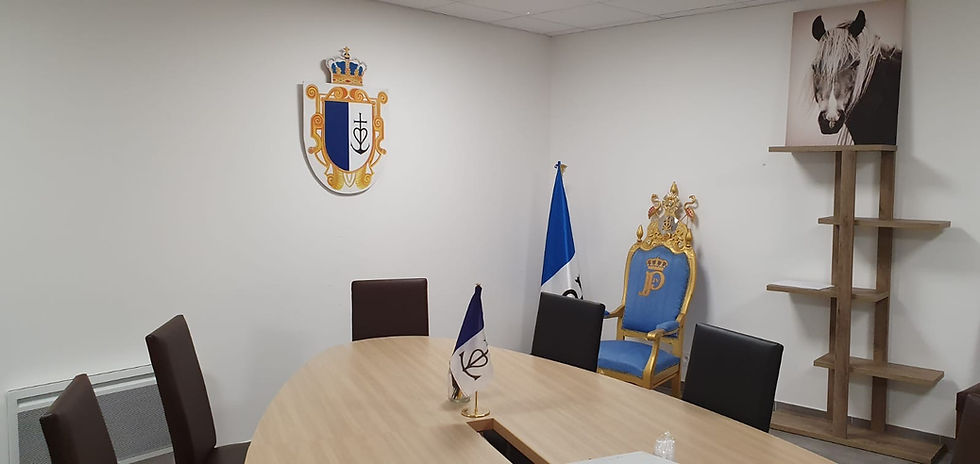
Cabinet's room at the Princely Palace
THE CHANCELLOR OF THE PRINCE OF AIGUES-MORTES
The Prince’s Chancellor is the equivalent of the Prime Minister in France. As provided for in our constitution, she was selected and nominated by the Prince to the General Assembly of Citizens, who approved her appointment before she could take office. She directs and coordinates the implementation of the initiatives and projects to which the Principality has committed. She is responsible for forming the cabinet, subject to the Prince’s approval. Cabinet members hold the status of ‘minister’. They are known as ‘Secretaries to the Prince’, and their departments are referred to as ‘Departments’ rather than ‘ministries’.
The Prince’s Secretaries and their respective departments are established according to the needs and actual areas of activity of the Principality. For example, you will not find a Department of Health, Education or the Armed Forces, as we neither build nor manage hospitals or educational establishments, nor do we possess an army in the strict sense of the term.
Also sitting in the Cabinet are senior officials of the Prince’s Palace directly responsible for matters of protocol and princely affairs. They work alongside the Prince’s Chamberlain, who is in charge of these matters. The Chamberlain is appointed by the Prince and selects his team, for which he is accountable to the Sovereign.
MEMBERS OF THE PRINCE'S CABINET


MEMBERS OF THE CABINET ATTACHED TO THE PRINCIAL PALACE